OBDII P Codes on an Aston Martin DB9

P Codes found on an Aston Martin DB9
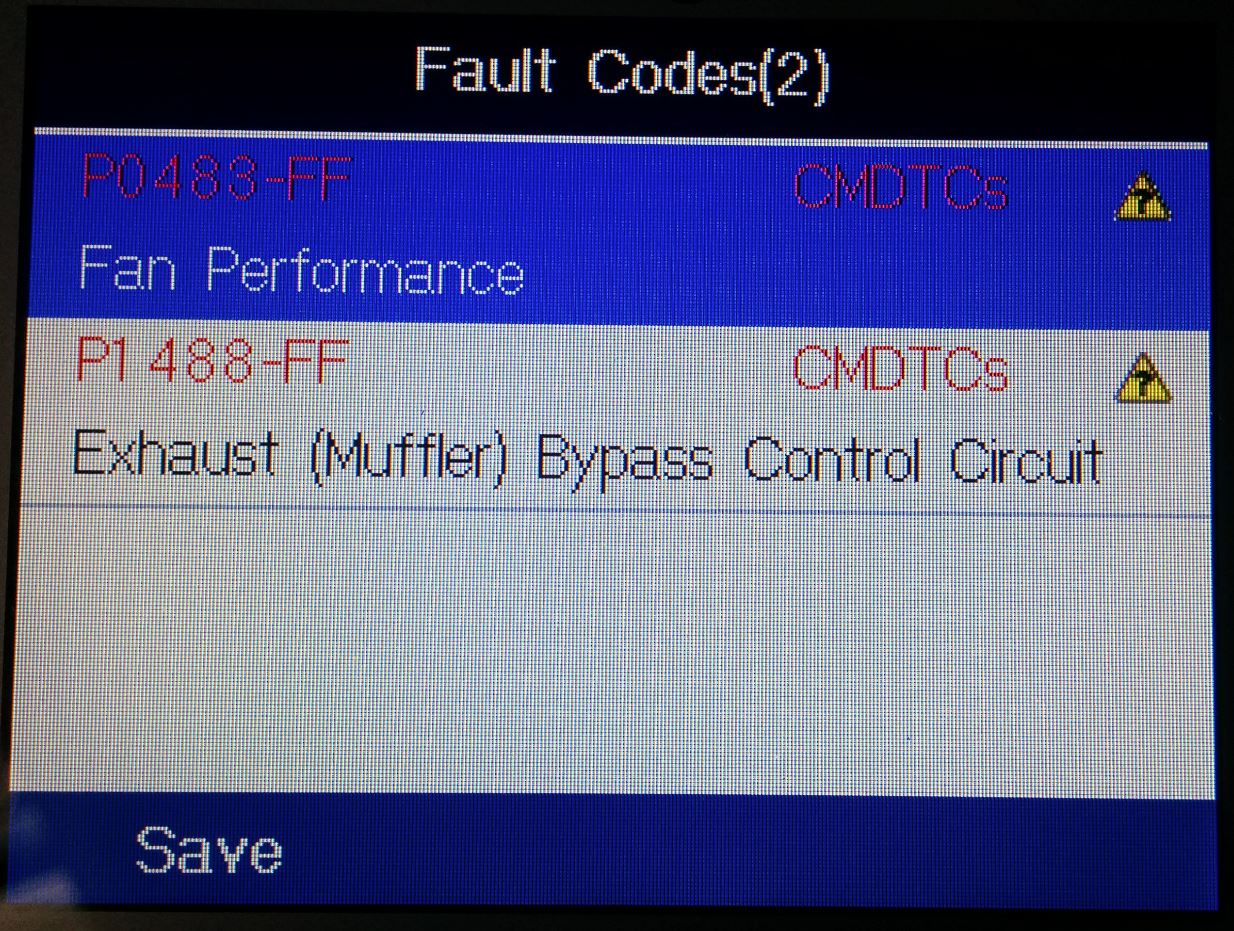
P Codes found by OBDII reader

While servicing your DB9 you might run into a situation where your dash display or OBDII reader shows you an error message in the form of a cryptic P code like P1488, setting the stage for an ominous visit to your local dealer and the commensurate drain on your bank account.  Without any reference, your tendency might be to stick your head in the sand and just drive on risking damage to the car.  In this post I wanted to publish a list of all the P codes I could find so that it might help steer you in the right direction to taking care of the issue yourself.

Some P codes are innocuous.   For example, P1488 [Exhaust (muffler) Bypass Control Circuit] is logged if you pull the famous Fuse 22 to uncork your exhaust.   The car knows Fuse 22 is pulled, makes a note of it, but doesn’t set off the idiot light (Malfunction Indicator Lamp or MIL).   If you find this code and you have pulled your fuse, you can just ignore it.

Aston Martin Diagnostic Manual

Aston Martin OBDII Diagnostic Manual - Preliminary Issue Cover
Download the Aston Martin OBDII Diagnostic Manual – Preliminary Issue

I have gathered the list below from a preliminary publication of the Aston Martin Factory “OBD II Diagnostic Manual” published in April 2004.   The publication is a great resource, and has a tremendous amount of detail about each P Code, and other theory about the cars operation and diagnostics.  356 pages of technical details and some very helpful diagrams.   Being that it was a preliminary publication it’s a good starting point for the early cars (MY 04/05/06), but I am certain that as the DB9 was developed more codes were added and this list is incomplete.   The official place to get the P codes explained is on the Aston Martin Technical Information Website (which I have covered in another blog post).   What I dislike about the format on the website is that the codes aren’t in a single document anymore, but rather each has its own web page section.  This makes a lot of sense for Aston Martin (alleviates the need to keep a large complicated document up to date), but for us DIY repair guys without an expensive $2,600 annual subscription to the website it’s a handicap.   So, I would recommend that if you find the P code you are experiencing in the list below just check out the PDF.   If the P code you have isn’t listed, perhaps spend the $100 for a one day subscription to the website and look up the code you have (and maybe send me the details or your code and a PDF print of what was on the website about it).  Or succumb, and take your car into the dealership. Continue reading “OBDII P Codes on an Aston Martin DB9”

Installing the Glove Box and Surrounding Panel on an Aston Martin DB9

Aston Martin Glove Box and Dash PanelsIf you’ve had to remove the Glove Box and Surrounding Panel on your DB9 as part of some other service event (such as changing your cabin air filters) you eventually need to reinstall it.   The process isn’t difficult and will only take about 5 minutes once you see how, but there is a little finesse required to get it put back together just right, and I wanted to share that with you here. Continue reading “Installing the Glove Box and Surrounding Panel on an Aston Martin DB9”

A Better Replacement Cabin Air Filter for an Aston Martin DB9

ATP Automotive Carbon Activated Premium Cabin Filter Part Number RA-16
Aftermarket Activated Carbon Cabin Air Filters

As part of my 2 year/20,000 mile service I was performing on my DB9 it was required to replace the cabin air/pollen filters.    I instinctively ordered a set of factory replacement filters, but stumbled across a forum post that suggested that the air filters in our beloved DB9 weren’t bespoke items, and were actually filters designed for a Mazda RX-8 and MPV minivan! Continue reading “A Better Replacement Cabin Air Filter for an Aston Martin DB9”

Changing the Cabin Air Filters on an Aston Martin DB9

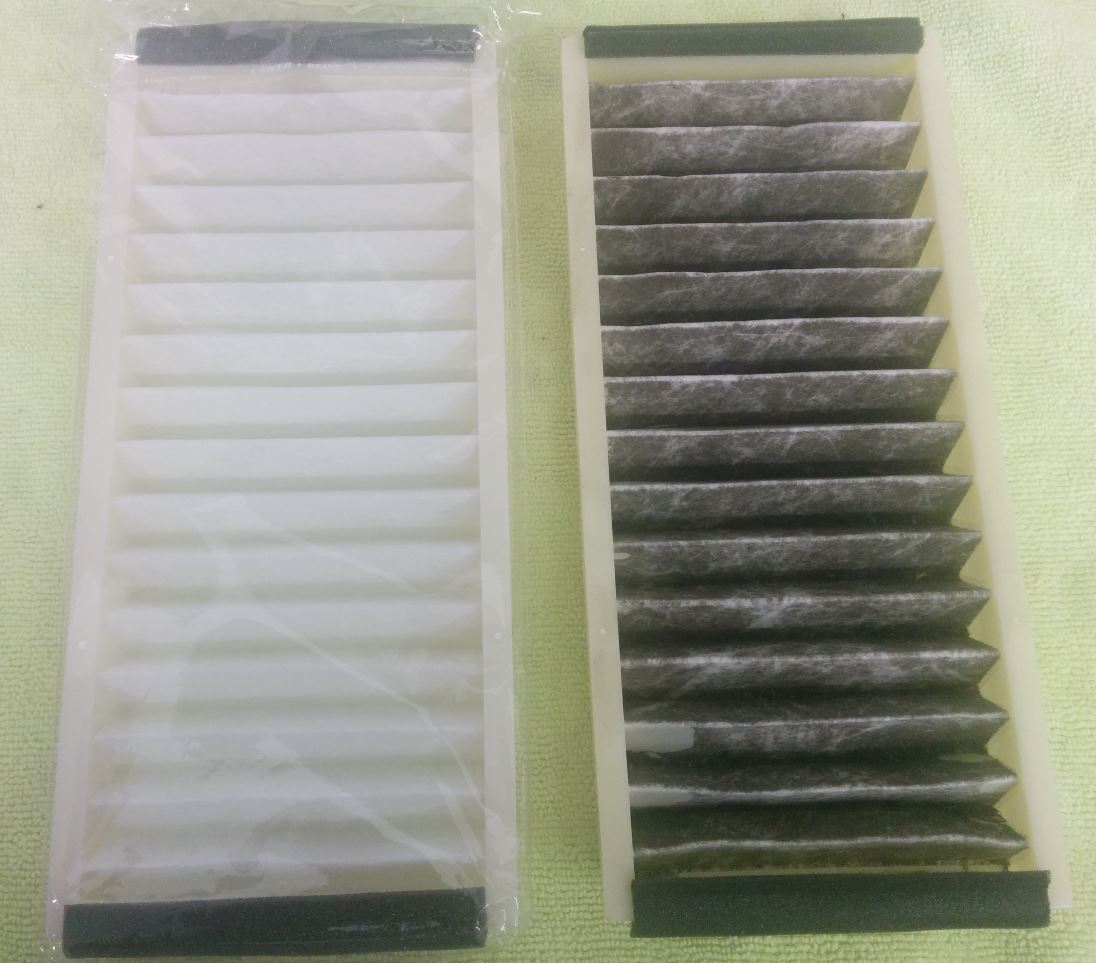
Clean and Dirty Aston Martin DB9 Cabin Air Filters
Clean and Dirty Cabin Air Filters

If you are doing your own 2 year/20,000 mile service on your DB9, one of the required service items is to change your cabin pollen filters.   Like anything on a DB9 this isn’t particularly simple, but can be done by just about anyone.   The process will take about 5 minutes once you see how.

Parts Needed

New Set of Cabin Air Filters for Aston Martin DB9
New Set of Cabin Air Filters

You will need a pair of replacement filter elements.   You can either purchase new filters from Aston Martin, or consider upgrading to aftermarket ATP Activated Carbon Air Filters that will add the benefit of odor removal as well as being better at pollen and dust removal.  I have another blog post on just this topic, and it have all the details on both the factory and aftermarket parts, so check it out. Continue reading “Changing the Cabin Air Filters on an Aston Martin DB9”

Removing the Glove Box and Surrounding Panel on an Aston Martin DB9

Aston Martin Glove Box and Dash Panels
DB9 Glove Box and Leather Surround

There may be a few reasons that you need to remove the Glove Box and surrounding dash panels on your DB9, but the most likely is that you are trying to change the Cabin Air Filters as part of a 2 year / 20,000 mile service and this step is necessary to access the filters.

The process is not difficult once you see how it’s done, and I encourage you to watch the short video below to bolster your confidence before you start reefing on panels willy-nilly.  I know I wish there was a video when I started on this.  Some of my background came from this AMOC post. Continue reading “Removing the Glove Box and Surrounding Panel on an Aston Martin DB9”

Generic OBDII Live Data you can get from your Aston Martin DB9

Aston Martin DB9 PCMUsing an OBDII code reader you can retrieve a substantial amount of data from your DB9’s Powertrain Control Modules (PCMs).   In an earlier blog post I explained how to connect an aftermarket OBDII code reader to the car.   In this post I want to detail the 45 pieces of Live Data information that will be accessible using the generic OBDII codes. Continue reading “Generic OBDII Live Data you can get from your Aston Martin DB9”

Getting more from your Aston Martin DB9 when using an OBDII Code Reader

Aston Martin DB9 PCMIn a previous post I explained how you can hook up an aftermarket OBDII Code Reader to your DB9 to retrieve Diagnostic information from the Power Train Control Modules (PCMs). What’s disappointing is that Aston Martin has kept much of their code system proprietary (accessible only via the Dealers more advanced AMDS system) and thus we can only get rudimentary information using the generic industry standard OBDII codes (check out my post on the 45 pieces of data available using this method) .

Ford LogoOn a lark I thought “Since Aston Martin was owned by Ford when the DB9 was initially designed and built, maybe the PCM’s are really programmed with Ford codes”.   There was some clue to this as well on the Aston Martin Technical Information website – in the early years of the DB9 the Dealers used the WDS system to access the PCMs (the predecessor to the current AMDS), which I discovered is Fords Worldwide Dealer System.  If the WDS is designed to talk to all the Ford models of the world would work for it, maybe this would work for me too. Continue reading “Getting more from your Aston Martin DB9 when using an OBDII Code Reader”

Live Data that can be accessed on your Aston Martin DB9 with an OBDII Code Reader

Aston Martin DB9 PCMIn previous posts I’ve explained how to connect and use an aftermarket OBDII code reader to talk to your DB9’s Powertrain Control Module (PCM), and how you can use a trick to tell your Code Reader to talk to the PCM as if it was a Ford 3.0L V6 to get vastly more live data than with the generic OBDII code scan.

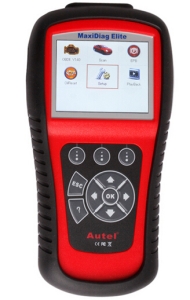
Autel MaxiDiag Elite MD802In this post I wanted to list the 200+ items that would be available to you if you follow this method (and so the Google search engines might index them and lead people back to this how to).  Maybe if you see what you are needing below, it will give you the confidence to move ahead and use a code reader to help you with your project. Continue reading “Live Data that can be accessed on your Aston Martin DB9 with an OBDII Code Reader”

Using an OBDII Code Reader with an Aston Martin DB9

Using an OBDII Code Reader with an Aston Martin DB9If you are interested in doing some of your own maintenance on your Aston Martin DB9 one great tool to have in your repertoire is an OBDII code reader.  OBDII stands for On Board Diagnostics version II – an industry standard communication method that modern cars with computers use.   By linking up your OBDII reader to the car, you can ‘talk’ to it, learning some real-time information from the cars Powertrain Control Modules (PCMs).

Aston Martin Check Engine Light
Dreaded Check Engine Light (CEL)

Of particular use is to understand what’s going on if the dreaded Check Engine Light (CEL) comes on.  This is also sometimes known as the Malfunction Indicator Light (MIL) or Idiot light.  Without a code reader you are completely in the dark as what might have tripped the CEL, and at the mercy of a Dealer to find out what’s going on.  With a code reader, you can link up to the car and it will tell you a much more specific error code (a P code in Aston Martin speak).   This will narrow down your troubleshooting greatly, and often it can be a simpler DIY issue to address and then clear the error code and reset the CEL. Continue reading “Using an OBDII Code Reader with an Aston Martin DB9”

Relearning the Misfire Correction Factors on an Aston Martin DB9

Aston Martin DB9 EngineWhat the hell is a Misfire Correction Factor and why should I care?   Exactly my thought as well – and as soon as your DB9’s battery goes dead or is disconnected for service work, you car will forget this critical engine tuning data and then you’ll care.

What makes this a bit more confusing is that the issue is described under many names, but all referring to the same thing:

  • Misfire Correction Factors
  • Coast down procedure
  • Adaptive Learning Procedure
  • Flywheel Learning Procedure

How Aston Martin Describes it

The Engine and Transmission Control Modules use an adaptive learning process to improve performance by compensating for manufacturing tolerances in the engine and transmission.  Benefits include:

  • More accurate misfire detection
  • Improved engine emissions
  • Smoother gear shifts

Continue reading “Relearning the Misfire Correction Factors on an Aston Martin DB9”