Live Data that can be accessed on your Aston Martin DB9 with an OBDII Code Reader

Aston Martin DB9 PCMIn previous posts I’ve explained how to connect and use an aftermarket OBDII code reader to talk to your DB9’s Powertrain Control Module (PCM), and how you can use a trick to tell your Code Reader to talk to the PCM as if it was a Ford 3.0L V6 to get vastly more live data than with the generic OBDII code scan.

Autel MaxiDiag Elite MD802In this post I wanted to list the 200+ items that would be available to you if you follow this method (and so the Google search engines might index them and lead people back to this how to).  Maybe if you see what you are needing below, it will give you the confidence to move ahead and use a code reader to help you with your project. Continue reading “Live Data that can be accessed on your Aston Martin DB9 with an OBDII Code Reader”

Using an OBDII Code Reader with an Aston Martin DB9

Using an OBDII Code Reader with an Aston Martin DB9If you are interested in doing some of your own maintenance on your Aston Martin DB9 one great tool to have in your repertoire is an OBDII code reader.  OBDII stands for On Board Diagnostics version II – an industry standard communication method that modern cars with computers use.   By linking up your OBDII reader to the car, you can ‘talk’ to it, learning some real-time information from the cars Powertrain Control Modules (PCMs).

Aston Martin Check Engine Light
Dreaded Check Engine Light (CEL)

Of particular use is to understand what’s going on if the dreaded Check Engine Light (CEL) comes on.  This is also sometimes known as the Malfunction Indicator Light (MIL) or Idiot light.  Without a code reader you are completely in the dark as what might have tripped the CEL, and at the mercy of a Dealer to find out what’s going on.  With a code reader, you can link up to the car and it will tell you a much more specific error code (a P code in Aston Martin speak).   This will narrow down your troubleshooting greatly, and often it can be a simpler DIY issue to address and then clear the error code and reset the CEL. Continue reading “Using an OBDII Code Reader with an Aston Martin DB9”

Relearning the Misfire Correction Factors on an Aston Martin DB9

Aston Martin DB9 EngineWhat the hell is a Misfire Correction Factor and why should I care?   Exactly my thought as well – and as soon as your DB9’s battery goes dead or is disconnected for service work, you car will forget this critical engine tuning data and then you’ll care.

What makes this a bit more confusing is that the issue is described under many names, but all referring to the same thing:

  • Misfire Correction Factors
  • Coast down procedure
  • Adaptive Learning Procedure
  • Flywheel Learning Procedure

How Aston Martin Describes it

The Engine and Transmission Control Modules use an adaptive learning process to improve performance by compensating for manufacturing tolerances in the engine and transmission.  Benefits include:

  • More accurate misfire detection
  • Improved engine emissions
  • Smoother gear shifts

Continue reading “Relearning the Misfire Correction Factors on an Aston Martin DB9”

Recalibrating the Door Window Glass Auto Drop Positioning on an Aston Martin DB9

Aston Martin DB9 Door GlassYour DB9 has a cool feature that when you open either door the window glass lowers slightly (drops) to allow it to clear the opening.  When you close the door the opposite happens and the window rises the final amount to seal up tight.  If the windows loose power the calibration to know where top and bottom are forgotten, and this feature stops working until you reset them.  Fortunately the procedure is simple and takes just a minute. Continue reading “Recalibrating the Door Window Glass Auto Drop Positioning on an Aston Martin DB9”

Preparing your Aston Martin DB9 for Track Day

You Own a DB9 – Now Act Like It

Steve-AM1
My DB9 at a Track Day

I think the phrase ‘Track Day’ gets a bad rapp in some of the Aston Martin forums.  If you are worried about your depreciation value more than enjoying your car, your reading the wrong blog.

We own beautiful cars that are technical mastery.  What’s the point of owning it if you aren’t interested in taking it out for a romp once in a while?   Just staring at it in the garage is only 1/3rd of the fun.  Sitting in it and fondling it is another third.  Taking it for a spirited drive is the last third. Continue reading “Preparing your Aston Martin DB9 for Track Day”

Performing a Seat Module Calibration on an Aston Martin DB9

Aston Martin DB9 SeatsSo this post is because one day I got into my car and discovered I couldn’t adjust my drivers seat.   Specifically:

  • I couldn’t adjust the seat back incline forward or back
  • I couldn’t adjust the seat bottom backwards – BUT – I could move it forward.
  • I couldn’t adjust the seat bottom back down – BUT – I could raise it.
  • I couldn’t adjust the seat bottom front down – BUT  – If I tried to raise it I could hear a motor click.  It was already all the way up.

What really sucked is that every time I fiddled with it, I would end up edging the seat forward a bit, and seat bottom back up a bit (the only two motions that worked).  Envision me slowly tipping up and squishing into the steering wheel.

Continue reading “Performing a Seat Module Calibration on an Aston Martin DB9”

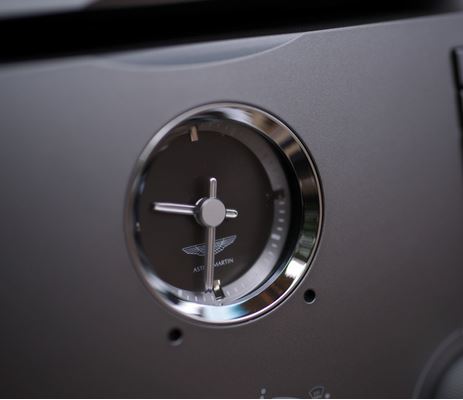
Adjusting the Time on the Clock in an Aston Martin DB9

Aston Martin DB9 ClockAt least twice a year you probably need to adjust the time on your DB9 dash clock (with the changes for daylight savings time).   Or maybe you’ve had your battery disconnected for a service event and the clocks time is off.  Personally I think the clock keeps accurate time, I’ve never needed to tweak the time due to it drifting on its own.

Changing the time is very simple and probably doesn’t warrant a post and video, but since it’s officially part of the Aston Martin Annual Service routine I thought I would do a quick one – some people are visual learners and are encouraged when they see others do it.

Flux Capacitor
Flux Capacitor

Just below the clock to the right and left are two small holes (with recessed adjustment buttons).  The left hand one turns the time backward.  The right hand one turns the time forward (all without 1.21 jigawatts of power and a flux capacitor!).

Continue reading “Adjusting the Time on the Clock in an Aston Martin DB9”

Torqueing the Wheel Nuts on an Aston Martin DB9

Torquing a Road Wheel on an Aston Martin DB9There are lots of reasons you might Torque the Wheel Nuts on  your DB9, but its anytime you’ve had a wheel removed or perhaps you are getting ready for a track day and should double check they are properly torqued.  I can tell you there is absolutely a wrong way to do it – just using an impact wrench and hammering them on until the gun stops turning.    Read on to learn the right way. Continue reading “Torqueing the Wheel Nuts on an Aston Martin DB9”

Lowering your Aston Martin DB9 Off Jack Stands

Aston Martin DB9 on Jack StandsNot every topic is all that exciting, but lowering your DB9 down off Jack Stands safely is important.   When you are to this point in a service project you are usually in a hurry just to get the car back on the ground and be done, but spend 1 minute and read on for a couple of quick tips I can share from my experience. Continue reading “Lowering your Aston Martin DB9 Off Jack Stands”

Installing a Road Wheel on an Aston Martin DB9

Installing the Road Wheel on an Aston Martin DB9There are a myriad of reasons you might have taken a Road Wheel off your DB9, but eventually it needs to go back on.  I know, I hear you laughing, how hard can this be.   It’s not hard, but there are a few tips I can share to help you get it done just the way Aston Martin wants. Continue reading “Installing a Road Wheel on an Aston Martin DB9”